
Save the Spring
At the end of 2023 we launched a multi-million-pound project to restore the River Dee for future generations, a partnership approach by the River Dee Trust, the Dee District Salmon Fishery Board, and the Atlantic Salmon Trust.
This innovative 20-year scheme is aimed at saving threatened species including the river’s iconic spring-run Atlantic salmon. It will also reduce the impacts of floods and droughts, benefitting all wildlife and communities, and it will involve the use of innovative science.
In January 2024 we held a number of stakeholder events locally and also online so that we could get the views of the wider public and allow people to ask questions before we formulated the details of the project plan. The video of the presentations from these events can be seen here on YouTube.
Read our monthly updates
Save the Spring strategy.
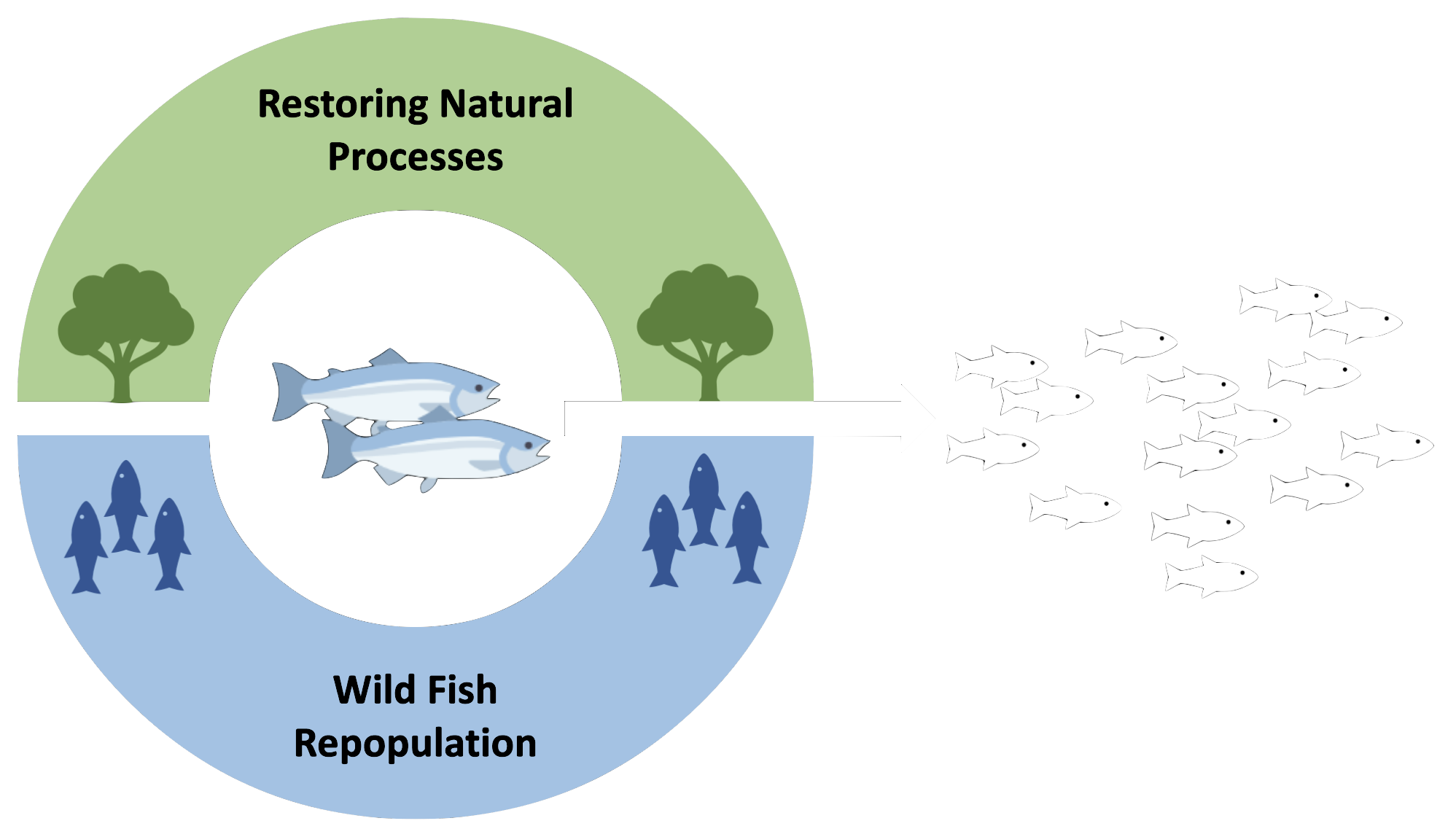
The programme takes a two-pronged strategy to restoring the Dee’s spring run wild Atlantic salmon.
Restoring Natural River Processes
The first part of this strategy is about restoring natural processes in the river and surrounding landscape.
The focus for this element of the strategy is on riverside woodland creation, peatland and wetland restoration, as well as re-naturalising the river channels.
This will help to reduce temperatures, control the flow of water off the land during flood events. It also means giving young salmon shelter from predators and extreme heat, additional benefits include improved aquatic habitat and plenty of invertebrate food for wildlife.
Wild Fish Repopulation
The second part of the strategic approach is about giving nature a helping hand and the focus is on maximising the number of wild adult salmon spawning in the river. This approach focuses on wild hatched salmon which survive best over the course of their life, survive better at sea, and produce more eggs than hatchery-raised fish.
Smolt to Adult Supplementation, where juvenile wild smolts captured from the river before their spring migration to sea, grown to adulthood and reproductive maturity in captivity in facilities at the University of Stirling, and then released back into the river as adults to spawn. Smolts have been collected from the Muick in Spring 2024, 2025 and 2026 and mature adults have been returned to spawn naturally in Autumn 2025 and will once again be returned in Autumn 2026. We then plan to look for juvenile progeny of these adults in 2027 to review the success of the programme with genetic sampling taking place.
Fundraising for Save the Spring
You can support the Save the Spring initiative as an individual or an organisation. Every pound raised helps move the project towards its fundraising goal.
Volunteering for Save the Spring
If you would like to register your interest as a project volunteer, either for the habitat restoration or fish capture elements of the programme, please contact the River Dee team.
Scroll down this page to see the FAQ’s from our stakeholder sessions.
Get in touch with the River Dee Team by emailing info@riverdee.org
For media enquiries please email debbie@riverdee.org

Frequently asked questions
Hidden to keep closed
Your content goes here. Edit or remove this text inline or in the module Content settings. You can also style every aspect of this content in the module Design settings and even apply custom CSS to this text in the module Advanced settings.
A loss of riverbed stability and salmon redds (nests) being washed out from damaging floods seems to be a key issue in the upper catchment. How can habitat restoration improve the situation?
The habitat restoration element of the strategy aims to, among a number of goals, slow the flow of water off the landscape. This will ultimately reduce the power of flood events and over time allow the river’s stability to settle and heal. Key to slowing the flow is riverside woodland restoration, and peatland and wetland restoration, using methods such as leaky dams to hold water back and allow it to enter the river channel more gradually. Many of these actions can bring immediate benefits, as well as longer-term ones.
How much habitat is the project looking to restore?
The programme is initially covering the river and tributaries above Aboyne, which is approximately 900km of stream length and around 1000km2 in area. The restoration strategy is being developed so that the partnership can prioritise sites for work, using information we have about their current status (e.g. salmon populations) and pressures (e.g. water temperature predictions). For example, 300km of streams are already highlighted as at risk of thermal stress.
How wide and large do riverside buffer strips need to be in order for them to have a positive impact on the aquatic environment?
The width of a riverside buffer strip and the management of its natural or semi-natural vegetation needs to be context-specific and take special account of the hydraulics of the river in the entire catchment. In general though, the bigger the buffer, the bigger the benefits to both the water quality and biodiversity.
The project concept mentions improving the estuary/marine transition zone. What does this mean and what can be achieved in this area?
Wild Atlantic salmon are vulnerable to impacts when transitioning between the freshwater and marine environment. In the Save the Spring initiative, the component of work focused on this area aims to define exactly what these impacts are (e.g. flows, temperatures, chemicals, predators, disturbance) in Stage 1, and then develop solutions to alleviate any issues identified.
Do spring salmon not also spawn in the lower parts of the river system?
Yes, they do, but we know that the upper parts of the catchment are the main spawning grounds for spring-running salmon so this is where our energy is best focused. What happens in the upper catchment also affects the lower catchment, so habitat restoration in these areas should bring benefits further downstream.
Is this a stocking programme?
No. Stocking is typically defined as the the artificial augmentation of natural salmon production by the addition of artificially extracted eggs or young fish bred in captivity. This project’s approach to wild fish repopulation does not propose to use fish as broodstock, extract salmon eggs from fish, hatch fish in captivity or stock artificially hatched fish into the wild. Instead the proposed approach is one of conservation translocation – the movement of a wild species from one place to another for conservation benefit. In this case, wild fish will be moved into captivity, reared to maturity, and then released back into the wild, at the same location from which they were captured, to breed naturally.
Why are wild salmon genetics so important to preserve?
Genetic diversity has enabled wild Atlantic salmon to be adaptable to change, a feature of the species which is especially important to preserve in the face of the rapid climate and environmental change of today’s world. The Dee’s wild Atlantic salmon populations have adapted to the distinctive characteristics of the catchment over thousands of years and preserving this genetic diversity will give them the best chance of adapting to future environmental change and recovering to sustainable levels.
Why is the project choosing its wild fish repopulation approach over a traditional hatchery which grows salmon from eggs and releases them into the river as fry, parr or smolts?
The project believes in preserving and restoring the Dee’s wild genetic strains of Atlantic salmon and that is why the approach is focused on wild spawning adults and wild hatched offspring. Evidence demonstrates that hatchery-raised stocked salmon survive poorer over the course of their lifecycle when compared to wild hatched fish, and exhibit natural selection towards the domestic environment – i.e. they become adapted to the hatchery and not to the wild. In the long-term, our ambition is to step back and leave behind a self-sustaining wild population, not run a perpetual artificial stocking programme.
Hidden to keep closed
Your content goes here. Edit or remove this text inline or in the module Content settings. You can also style every aspect of this content in the module Design settings and even apply custom CSS to this text in the module Advanced settings.
What about using adult salmon as broodstock and then planting out fertilised eggs into the river? Would this not have the same ‘wild hatched’ effect but give you more control?
The project takes the approach that the wild Atlantic salmon in the Dee, which have adapted to their environment over thousands of years, should be allowed to go through their natural spawning behaviour – choosing an appropriate mating partner, building their redd (nest), choosing where to deposit their eggs, and choosing when to deposit their eggs. This approach allows wild Atlantic salmon to complete their natural lifecycle. Evidence supports the importance of preserving natural mate-selection behaviour in wild salmon to benefit offspring health, including wild Atlantic salmon.
Why is the project proposing to use facilities at the University of Stirling Institute of Aquaculture rather than a facility on Deeside?
Working with the University of Stirling will enable us to make use of the very best fish rearing facilities with a large, biosecure capacity to support the project as it grows, as well as to harness the vast experience and expertise of their staff. This experience will be invaluable when it comes to feeding, biosecurity, fish health and welfare, and maintaining the best possible environmental conditions for wild fish growth.
Will the kelts and smolts be reared in freshwater or saltwater?
Both. The University of Stirling’s facilities have the ability to transition fish between both freshwater and saltwater systems. This will allow us to best replicate natural conditions. Evidence indicates that saltwater growth produces more and better quality eggs than purely freshwater-reared salmon.
How many fish could the facilities handle and how many kelts and smolts does the programme hope to capture every year?
The facilities can initially accommodate the rearing of several hundred smolts, beginning with around 100 in the first instance, and up to 50 kelts. With careful forward planning, and agreed funding in place, there is capacity for this number to be increased in future years, with dedicated sections of the facilities being assigned exclusively to assisting with wild salmon restoration programmes.
How will the project monitor increasing fish numbers to demonstrate success?
Demonstrating success comes down to effective monitoring and reporting. Key to this will be genetic monitoring which can map the parental lineages of juveniles caught in the wild to match them up with fish from the programme. For example, if we electro-fish an area where wild fish repopulation has previously taken place, we will be able to tell from genetics which wild fry and parr were hatched from the wild fish we previously interacted with. Sampling migrating smolts caught in traps will allow us to calculate the overall juvenile production resulting from the repopulation methods
Will in-river seal predation impact the project?
In-river seal predation has the potential to either prevent or slow the recovery of the river’s wild Atlantic salmon population. The Dee District Salmon Fishery Board is in conversation with Scottish Government and its agencies to seek support for management measures to reduce this pressure.
How is the project funded?
The first 5-year period of the project has a budget of £2m with £500,000 in private funding already raised. We are now actively fundraising for the remaining sums required to take the project forward.
Is any of the funding from salmon farming companies?
No.
Can members of the public get involved and volunteer?
When the programme is fully up and running we intend to create a volunteer registration portal so members of the public can join us and get involved in both the habitat restoration and wild fish repopulation elements of the project.
What’s happening next?
Teams from the River Dee and the Atlantic Salmon Trust are now drawing up habitat restoration and wild fish repopulation plans in greater detail, are in conversation with Scottish Government and its agencies to secure the necessary licences and are working with the University of Stirling to prepare to take wild smolts and kelts into their facilities this year